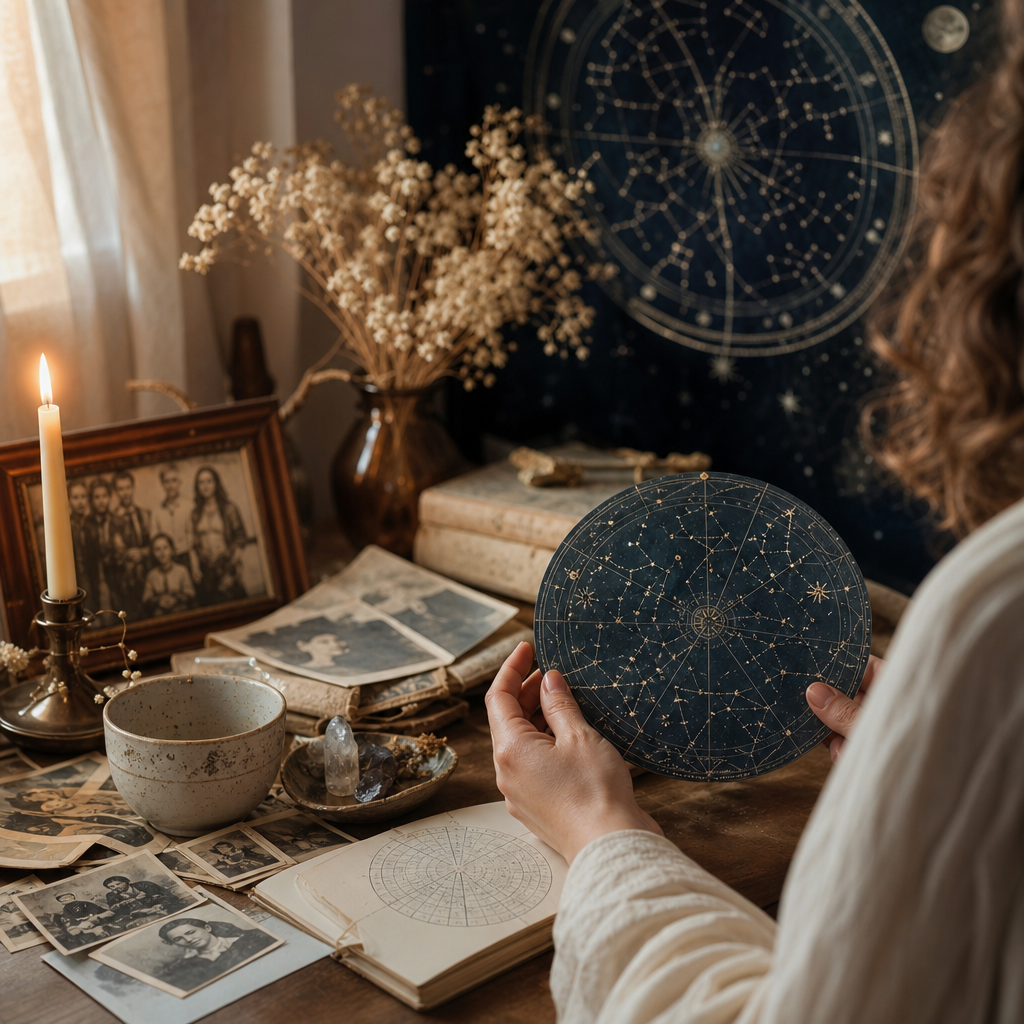
Ancestral astrology invites you to see your birth chart as more than a personal blueprint, it’s also a map of the family line that shaped you long before you took your first breath. This gentle practice looks at recurring themes, sensitive placements, and generational echoes that show up again and again across a lineage, from money patterns to relationship habits to the way love and grief get handled at home.
It doesn’t offer proof or predictions; instead, it offers a reflective lens for noticing what you might be carrying, and what you might be ready to set down. Many people come to ancestral astrology after noticing a pattern repeat in their own life that also showed up in a parent’s or grandparent’s story. This article walks through what ancestral astrology actually looks at, the chart placements most associated with family history, and some grounded, practical ways to explore it for yourself.
Table of Contents
What Is Ancestral Astrology?
At its core, ancestral astrology is the practice of reading a birth chart for clues about inherited family dynamics, not just your own personality traits or daily transits. It draws on the idea that certain placements and aspects can point toward themes that have moved through a family line for generations, sometimes without anyone naming them out loud. This isn’t a mainstream branch of astrology with one agreed-upon rulebook. Different practitioners emphasize different techniques, from specific houses to nodal placements to comparing a person’s chart with their parents’ charts.
What they share is a belief that our charts don’t exist in isolation, they sit inside a much longer family story. It’s worth being clear-eyed here: ancestral astrology is a reflective and symbolic tool, not a diagnostic one. It can offer language and imagery for patterns you already sense, but it isn’t a substitute for genealogical research, medical history, or professional support when something feels heavier than a chart alone can hold.
How Ancestral Astrology Reveals Family Patterns
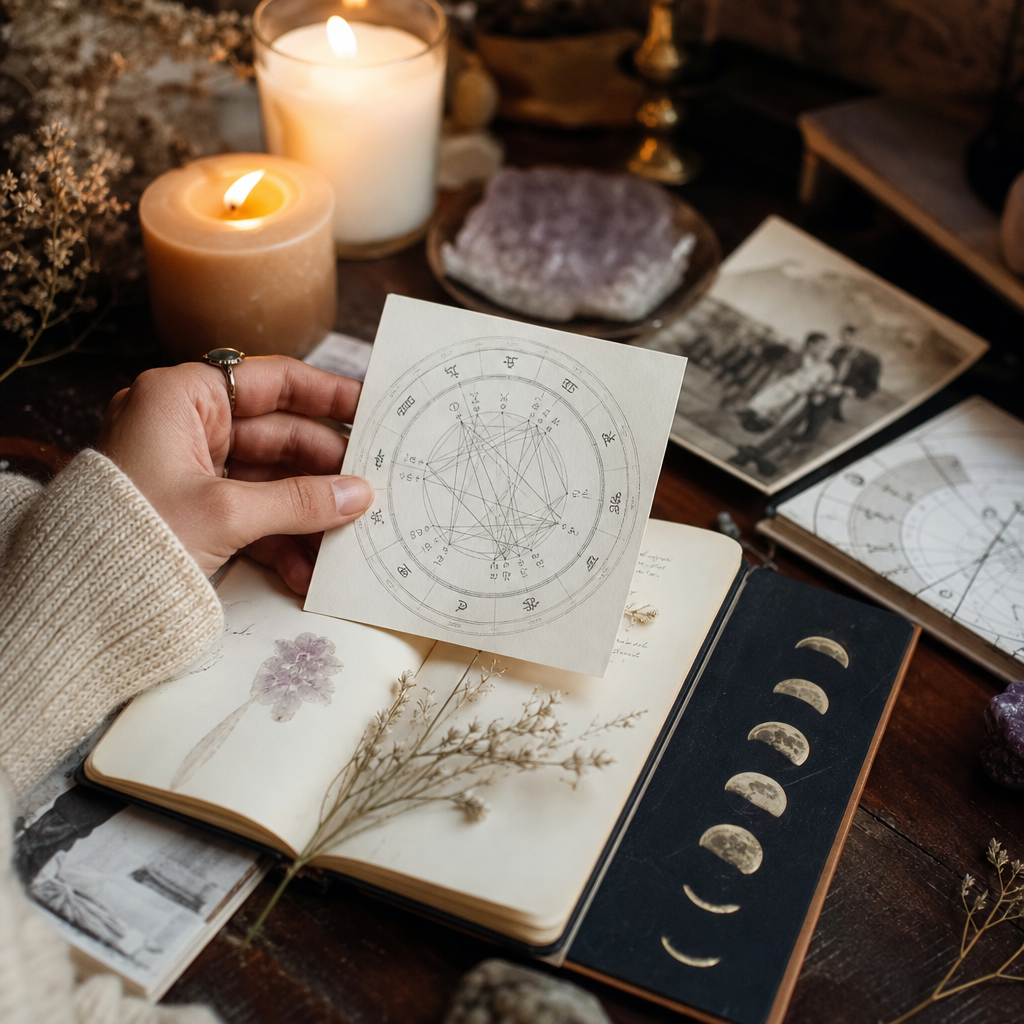
A few areas of the birth chart come up again and again when people study ancestral astrology. These points aren’t destiny, they’re more like doorways worth knocking on if a theme keeps resurfacing in your life.
The IC And Fourth House
The Imum Coeli (IC) sits at the base of the chart and is often described as the root of the wheel. In ancestral astrology, this point and the fourth house it anchors are frequently linked to home, lineage, and the emotional inheritance passed down through family. Placements here, planets, tough aspects, or a heavily populated fourth house, are sometimes read as clues about the emotional climate a person was born into, including unspoken family rules around safety, belonging, or worth. Some practitioners also connect these themes to the body’s energy centers, seeing the root chakra’s focus on safety and belonging as a physical echo of what the fourth house describes astrologically.
The Eighth House
The eighth house is traditionally tied to shared resources, intimacy, and what gets inherited, financially, emotionally, and otherwise. Within ancestral astrology, it’s often examined for themes around family secrets, loss, or the way power and control moved through past generations. Someone with a strong eighth house emphasis might feel drawn to understanding what was left unspoken in their family, even if they can’t yet name why.
The Twelfth House
The twelfth house is associated with what’s hidden, collective, or quietly carried, sometimes described as the house of the unconscious. In ancestral astrology, it’s frequently connected to grief that was never fully processed, or patterns a family agreed, without ever saying so, not to talk about. This house can also point toward gifts: intuition, sensitivity, or a pull toward healing work that may have skipped a generation or two before landing with you.
Generational Influences And Inherited Patterns
Family patterns rarely arrive with an instruction manual. A tendency toward anxious caretaking, a hard time trusting partners, or a recurring financial struggle can show up in one generation after another without anyone consciously choosing it. Ancestral astrology offers a way to notice these threads by looking at repeating placements or themes across a family’s charts, when that information is available, or by looking at your own chart as a kind of composite of what came before you.
It’s a way of asking: what did the people before me have to survive, and what did they pass down, intentionally or not, because there wasn’t room or safety to process it another way?
Recognizing Ancestral Trauma Through A Reflective Lens
Researchers who study family systems and intergenerational stress have found that patterns of coping, including anxiety and hypervigilance, can be shaped by what previous generations lived through. This is an active and evolving area of psychological research, and it’s separate from what astrology can measure or prove. Ancestral astrology doesn’t replace that science, it sits alongside it as a symbolic, reflective practice.
If you notice a pattern that feels bigger than a chart conversation, working with a licensed therapist or counselor can offer support that a spiritual practice alone isn’t designed to provide. For readers who want a grounded, research-based starting point on how stress and family history can intersect, the National Institute of Mental Health offers accessible resources worth exploring.
A Brief Timeline: How Ancestral Astrology Has Evolved
Astrology’s attention to lineage isn’t new. Ancient astrological traditions, including Hellenistic and Vedic systems, often included family houses and hereditary significators as a standard part of chart reading, long before the term ‘ancestral astrology’ existed. Medieval and Renaissance astrologers frequently cast charts for entire households, treating family fortune and reputation as something read through a single chart. The individual-focused astrology that’s common today is actually a fairly modern shift.
The specific label ‘ancestral astrology’ has become more visible in the last few decades, growing alongside a broader cultural interest in generational healing, family systems work, and ancestor-honoring practices from many cultural traditions. It’s less a brand-new invention than a renamed return to something astrology has quietly done for centuries.
Practical Steps To Explore Your Ancestral Chart
If you’d like to explore ancestral astrology for yourself, you don’t need advanced training to begin. A slow, curious approach works better than trying to decode everything at once.
Step One: Gather What You Can
Start with your own birth chart, calculated with an accurate birth time if possible. If you know approximate birth information for a parent or grandparent, having those charts on hand can add helpful context, though it’s entirely optional.
Step Two: Look For Repeating Themes
Rather than hunting for one dramatic answer, look for themes that repeat: a particular house that’s heavily emphasized, a hard aspect that shows up in similar form across charts, or a sign that seems to color how your family handles conflict or affection.
Step Three: Journal Before You Judge
Write down what you notice without immediately deciding what it means. Ask yourself where you’ve seen this pattern show up in daily life, and whether it feels like something you want to keep, adjust, or gently release.
Step Four: Bring In Reflection, Not Certainty
Treat your findings as a conversation starter, not a verdict. Ancestral astrology works best as an invitation to reflect, not as a fixed explanation for why your family is the way it is.
Healing And Breaking Ancestral Cycles
Noticing a pattern is different from being stuck with it forever. Many people who explore ancestral astrology are looking for a starting point toward change, not just a description of what’s already true. Simple, grounded practices can support this kind of reflection. Lighting a candle while naming what you’re choosing to release, writing a letter to an ancestor you never met, or simply pausing at the new moon to set an intention around a specific pattern are all approachable ways to begin.
None of these practices guarantee a particular outcome, and they aren’t a replacement for the deeper support a mental health professional can offer when a pattern involves real trauma, grief, or abuse. They’re best understood as companions to that support, not substitutes for it. If a family memory feels overwhelming or unsafe to sit with alone, a licensed therapist or a crisis line is the right resource for that moment.
Rituals For Honoring And Releasing
Consider pairing your ancestral astrology reflections with a small nervous-system check-in, since old patterns often live in the body as much as in the mind. If tightness or old fear tends to surface during this kind of reflective work, the guidance in Nervous System Regulation and Spiritual Healing: A Grounded Path to Feeling Safe Again can help you build a sense of safety before and after these sessions.
You might also try a short reset practice on a difficult anniversary or family date, giving yourself a few quiet minutes to breathe and realign rather than reacting on autopilot. The ideas in Cosmic Reset Rituals: A Grounded Guide to Realigning Your Mind, Heart, and Relationships pair naturally with this kind of ancestral reflection.
Ancestral Astrology And Relationship Wellness
Family patterns don’t stay contained to the family you grew up in, they often show up in the partnerships you build as an adult. A tendency to shut down during conflict, or to over-function to keep everyone calm, can trace back further than the relationship you’re currently in. Looking at ancestral astrology alongside a partner, comparing what each of you learned about love, safety, and conflict at home, can open up conversations that feel less like blame and more like curiosity. When old family patterns show up as tension between partners, quick escalation, shutting down, or feeling flooded during a disagreement, it often helps to steady the nervous system together first.
Nervous System Regulation for Couples: Finding Calm Together When It Matters Most offers grounded tools for pausing before old reflexes take over. Understanding where a reaction might have originated doesn’t excuse harmful behavior, but it can soften judgment and open the door to more honest, compassionate conversations about what each of you needs going forward.
How Ancestral Astrology Compares To Other Ancestor-Honoring Traditions
Ancestral astrology isn’t the only lens for thinking about inherited family patterns. Many cultural and spiritual traditions around the world include practices for honoring ancestors, from altar-building and storytelling to specific remembrance days. What sets ancestral astrology apart is its use of the birth chart as the primary text , a symbolic map rather than a spoken family history or a physical altar. It can sit comfortably alongside other ancestor-honoring practices you already hold, rather than replacing them.
If your family has its own traditions around remembering those who came before, ancestral astrology can complement that history by offering another angle to reflect from, without asking you to set anything aside.
FAQ
Is ancestral astrology the same as karmic astrology?
They overlap but differ in focus. Karmic astrology centers on individual soul lessons across lifetimes, while ancestral astrology examines patterns inherited through your family line specifically.
Do I need my ancestors' birth charts to practice ancestral astrology?
No. While having a parent's or grandparent's chart adds context, ancestral astrology works with your own birth chart alone, as it's believed to reflect inherited family themes.
Can ancestral astrology help me understand family trauma?
It offers reflective language for patterns you've noticed, but it's not diagnostic. For real trauma, a licensed therapist is better equipped to support direct healing.
How is ancestral astrology different from a standard astrology reading?
Standard readings focus on personality, timing, or transits. Ancestral astrology examines specific houses and placements thought to reflect family history and generational themes.
Where should I start if ancestral astrology is new to me?
Begin with your own birth chart and explore the fourth, eighth, and twelfth houses. Journal what feels familiar and treat insights as starting points for reflection.
Written by Sage Whitfield, Practicing Astrologer & Ritual Guide. Sage has spent over a decade studying astrology, moon cycles, and ritual practice, and writes about building simple, grounded rituals for everyday spiritual wellness.
This article is for informational and inspirational purposes only and is not a substitute for professional medical, mental health, legal, or financial advice. Always consult a qualified professional for guidance specific to your situation.